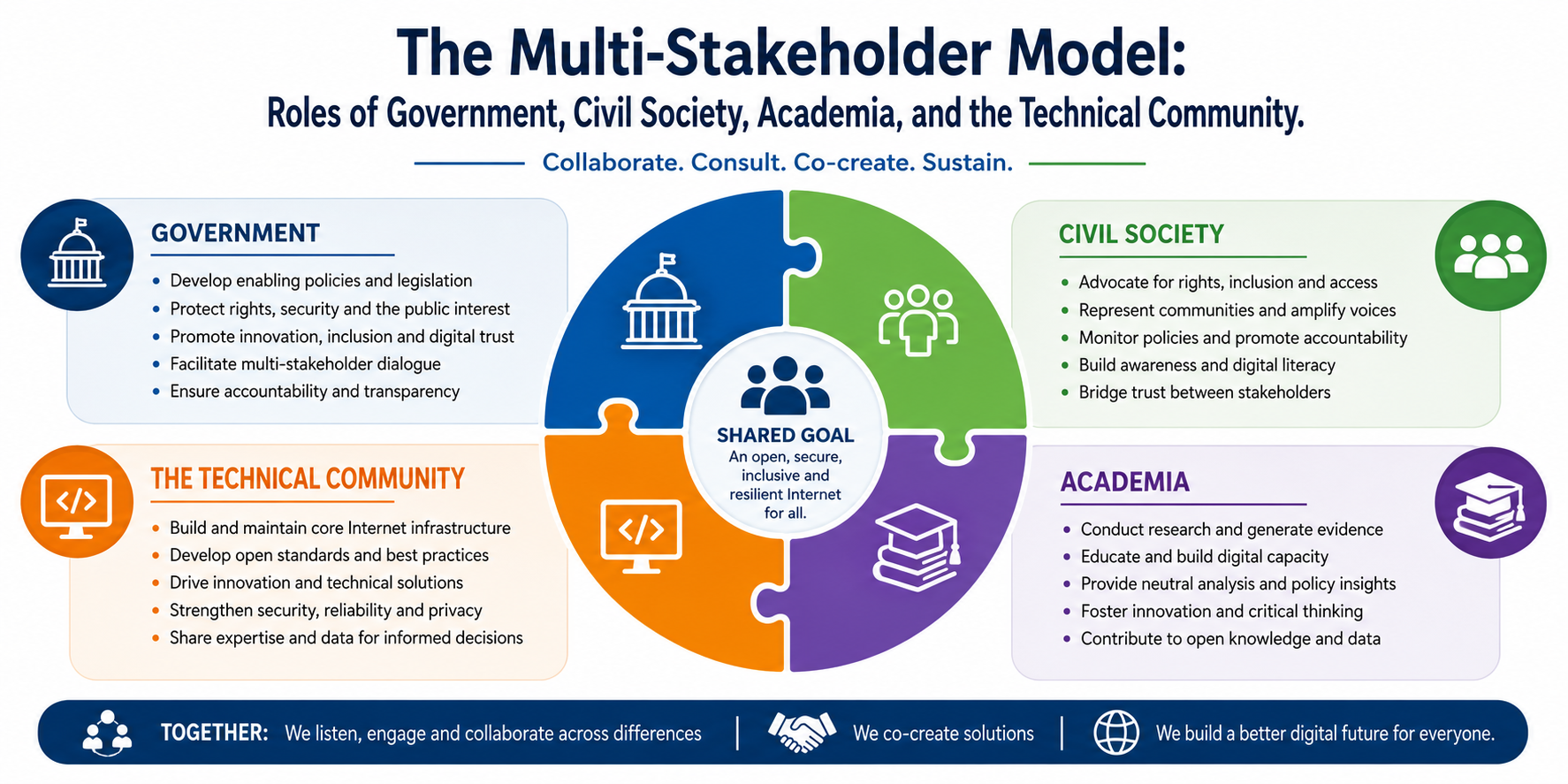
The Multi-Stakeholder Model: Roles of Government, Civil Society, Academia, and the Technical Community.
The Multi-Stakeholder Model of Internet governance is a decentralized framework where policy and technical decisions are made collaboratively across distinct sector groups, rather than through a single centralized government or top-down treaty organization.
Unlike traditional multilateral governance—where sovereign states hold exclusive decision-making power—multi-stakeholder governance operates on consensus, openness, and distributed authority.
Key Stakeholder Roles
1. Government & Public Authorities
-
Primary Focus: Public policy, legal frameworks, consumer protection, national security, and digital inclusion.
-
Core Function: Governments set baseline legal environments (e.g., data privacy laws like GDPR, cybercrime legislation) and advocate for the public interest. Within consensus bodies like ICANN (via the Governmental Advisory Committee), governments provide non-binding advice on public policy implications rather than dictating technical outcomes.
2. The Technical Community
-
Primary Focus: Network stability, interoperability, open standards, and security infrastructure.
-
Core Function: Encompassing bodies like the Internet Engineering Task Force (IETF), Internet Architecture Board (IAB), Regional Internet Registries (RIRs), and root server operators, this group builds and maintains the core protocols (TCP/IP, DNS, BGP). Decisions are driven by rough consensus and running code, ensuring technical feasibility comes before policy mandates.
3. Civil Society
-
Primary Focus: Human rights, digital equity, freedom of expression, privacy, and user advocacy.
-
Core Function: Non-governmental organizations (NGOs), human rights defenders, and end-user coalitions serve as the ethical compass of Internet policy. They ensure governance decisions respect user privacy, resist authoritarian censorship, and promote affordable access for underserved communities.
4. Academia & Research Institutions
-
Primary Focus: Empirical research, threat analysis, policy impact studies, and talent development.
-
Core Function: Researchers and academic institutions provide objective, evidence-based data on topics ranging from DNS abuse and network fragmentation to cybersecurity trends and economic impacts. They act as neutral analytical grounds for evaluating policy proposals.
(Note: The Private Sector & Industry also acts as a primary pillar alongside these four, operating infrastructure, funding innovation, and executing service delivery.)
How the Pillars Interact
                ┌─────────────────────────────────────────┐
                │        THE INTERNET ECOSYSTEM           │
                └────────────────────┬────────────────────┘
                                     │
         ┌───────────────────────────┼───────────────────────────┐
         ▼                           ▼                           ▼
┌──────────────────┐       ┌──────────────────┐       ┌──────────────────┐
│   GOVERNMENTS    │       │TECHNICAL COMMUNITY│      │  CIVIL SOCIETY   │
│ Public Policy &  │◄─────►│ Core Protocols & │◄─────►│ Human Rights &   │
│ Legal Frameworks │       │ Infrastructure   │       │ User Advocacy    │
└────────┬─────────┘       └─────────┬────────┘       └────────┬─────────┘
         │                           │                         │
         └───────────────────┐       │       ┌─────────────────┘
                             ▼       ▼       ▼
                      ┌─────────────────────────────┐
                      │    ACADEMIA & RESEARCH      │
                      │ Empirical Analysis & Data   │
                      └─────────────────────────────┘
The strength of this framework lies in its checks and balances:
-
Technical bodies prevent governments from passing policies that would break Internet functionality.
-
Civil society holds both governments and corporations accountable to human rights standards.
-
Academia supplies the neutral data needed to ground debates in reality rather than political rhetoric.