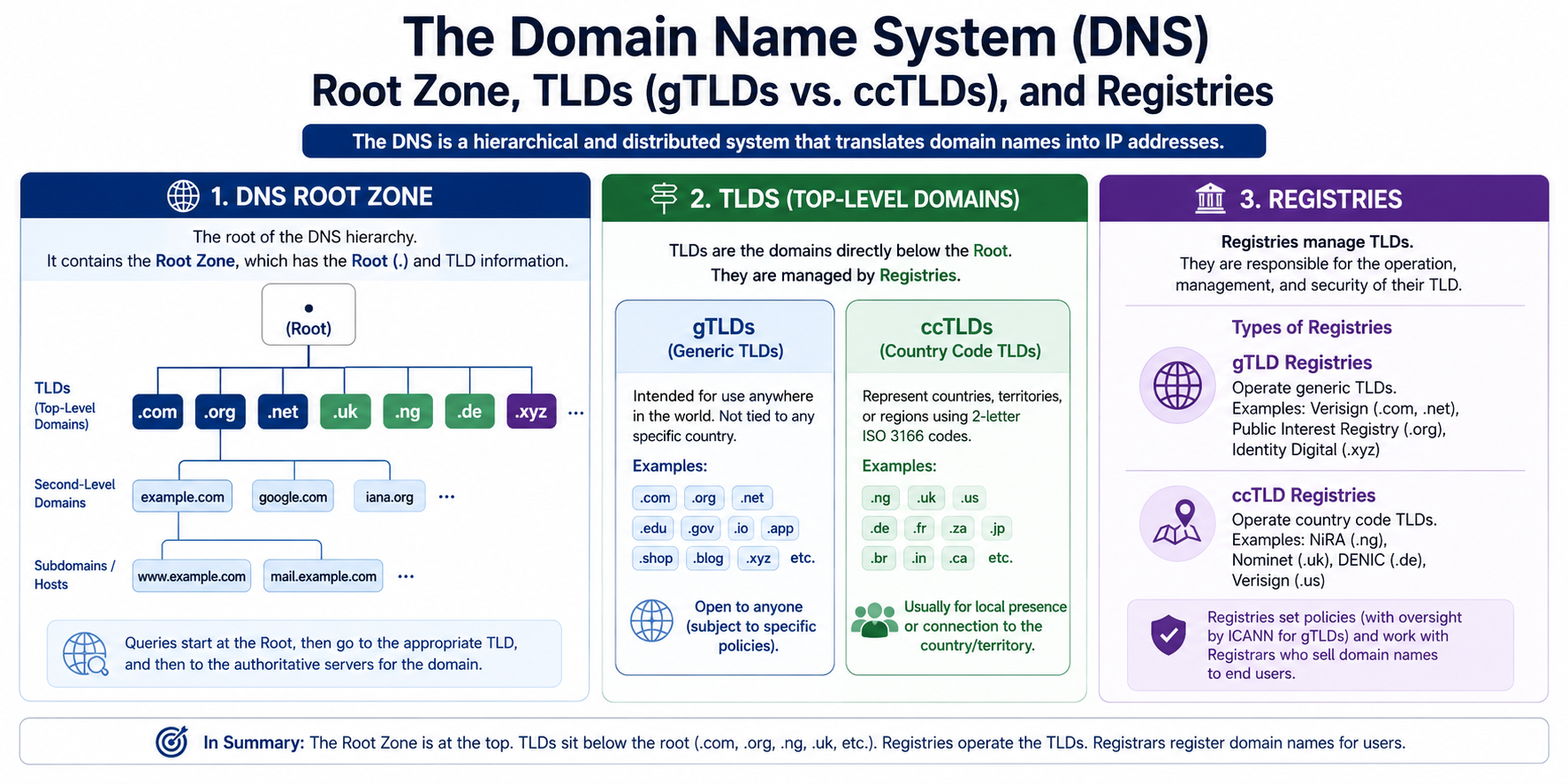
The Domain Name System (DNS) Root Zone, TLDs (gTLDs vs. ccTLDs), and Registries.
The Domain Name System (DNS) operates as the administrative and technical address book of the Internet. Structured like an inverted tree, it translates human-readable domain names (such as example.com) into machine-routable IP addresses (such as 193.0.14.129 or 2001:7fd::1).
Understanding how this hierarchy functions requires looking at its core layers: the Root Zone, Top-Level Domains (TLDs), and the Registries that operate them.
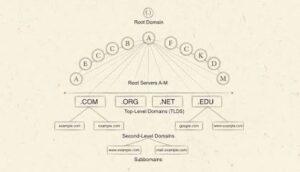
1. The DNS Root Zone
At the top of the DNS hierarchy sits the Root Zone, represented symbolically by a single dot (.).
-
Function: The root zone does not contain individual website IP addresses. Instead, it holds authoritative pointers (NS records) directing DNS resolvers to the authoritative servers for every Top-Level Domain (e.g.,
.com,.uk,.org). -
Governance: ICANN (Internet Corporation for Assigned Names and Numbers) oversees root zone management, with IANA (Internet Assigned Numbers Authority) handling operational updates and VeriSign serving as the root zone maintainer.
-
Root Servers: The root zone is served by 13 root server IP addresses (named
A.ROOT-SERVERS.NETthroughM.ROOT-SERVERS.NET), operated by 12 independent organizations. Through anycast routing, these 13 IP addresses correspond to thousands of physical servers globally for speed and DDoS resilience.
2. Top-Level Domains (TLDs): gTLDs vs. ccTLDs
Directly below the root zone are Top-Level Domains (TLDs). These are categorized based on their purpose, governance structure, and geographic scope:
Generic Top-Level Domains (gTLDs)
gTLDs are global extensions open to users worldwide (or specific industries).
-
Legacy gTLDs: Original domain spaces created in the 1980s, such as
.com,.net,.org,.gov,.edu, and.mil. -
New gTLDs (nTLDs): Introduced via ICANN’s 2012 expansion program to increase competition and choice (e.g.,
.app,.tech,.london,.bank). -
Policy & Oversight: Governed directly by ICANN policies, contractual compliance agreements, and standardized dispute resolution mechanisms like the UDRP (Uniform Domain-Name Dispute-Resolution Policy).
Country Code Top-Level Domains (ccTLDs)
ccTLDs are two-letter extensions reserved for specific countries, territories, or sovereign states based on the ISO 3166-1 alpha-2 standard (e.g., .uk for the United Kingdom, .jp for Japan, .de for Germany, .ng for Nigeria).
-
Governance: Delegated to designated local managers or national communications authorities.
-
Policy Independence: ccTLD policies—such as presence requirements, registration restrictions, and abuse policies—are determined locally by national registries rather than mandated by ICANN.
3. The Domain Ecosystem: Registries, Registrars, and Registrants
The domain ecosystem relies on a three-tier administrative structure known as the 3-R Model:
| Role | Definition | Key Responsibilities | Examples |
| Registry | The master database operator for a specific TLD. | Maintains authoritative WHOIS/RDAP data, zone files, and DNSSEC keys for the entire TLD. | Verisign (.com/.net), PIR (.org), Nominet (.uk) |
| Registrar | Commercial entities accredited to sell domains to the public. | Interface between buyers and registries; handles domain creation, renewals, and DNS settings. | Namecheap, GoDaddy, Cloudflare |
| Registrant | The individual or organization holding the domain. | Holds legal right of use for the domain for a paid lease period. | End users, businesses |
Key Differences at a Glance
       [ DNS Root Zone (.) ]  <-- Managed by IANA / ICANN
                 |
   +-------------+-------------+
   |                           |
[ gTLDs ]                  [ ccTLDs ]
.com, .org, .app           .uk, .de, .jp
Subject to ICANN contracts  Regulated by national authorities