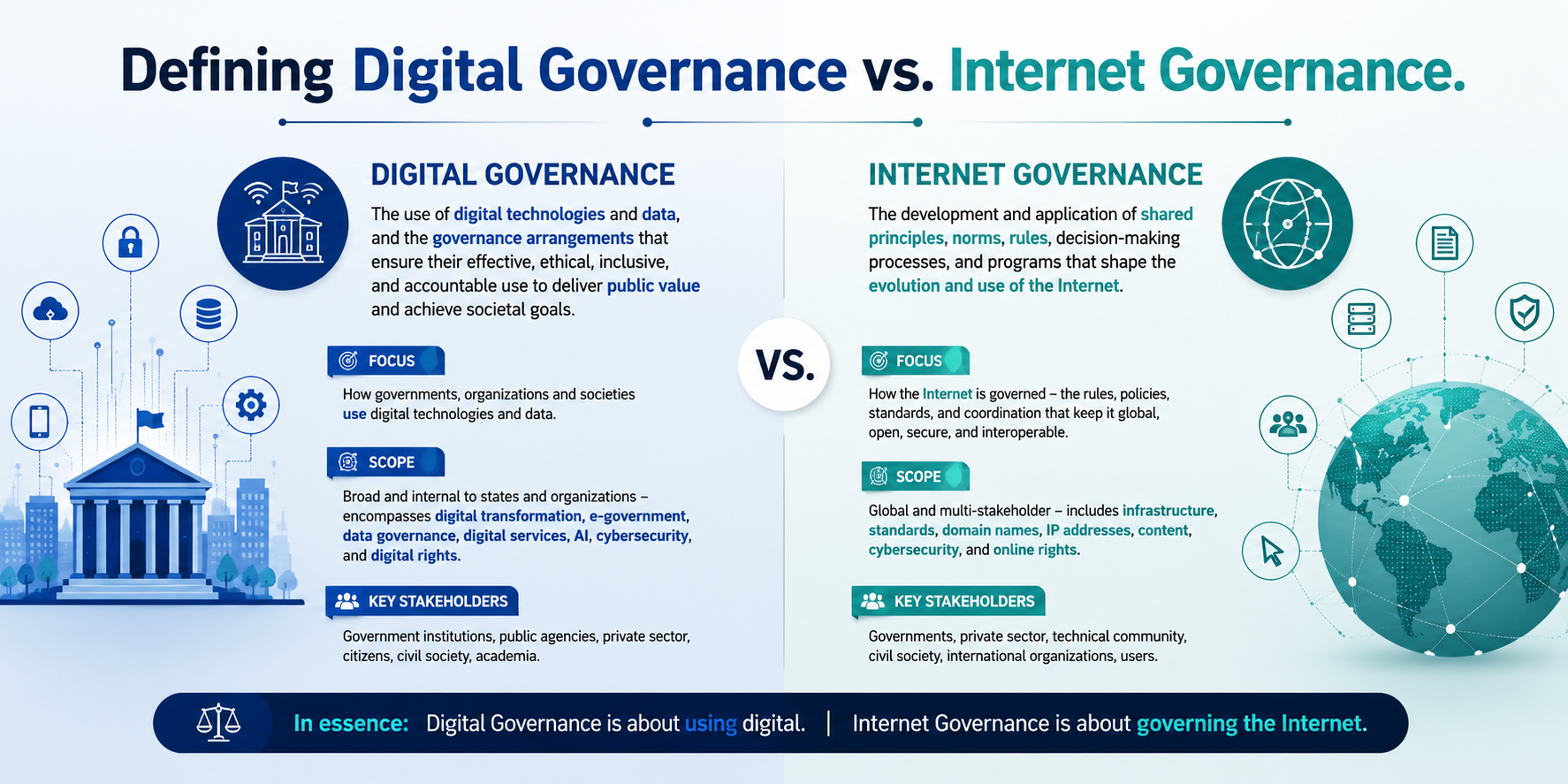
Defining Digital Governance vs. Internet Governance.
While Internet Governance and Digital Governance are often used interchangeably in casual conversation, they cover fundamentally different scopes: one manages the pipes and protocols that make the global network function, while the other governs the data, platforms, and societal impacts built on top of it.
At a Glance: Key Differences
| Feature | Internet Governance | Digital Governance |
| Core Focus | Technical infrastructure, protocols, connectivity, and network stability. | Data flows, artificial intelligence, digital platforms, and societal transformation. |
| Primary Scope | How the Internet works. | How digital technology impacts society, economies, and citizens. |
| Key Issues | Domain Name System (DNS), IP allocation, net neutrality, routing security (BGP), standards. | Data privacy (GDPR), AI regulation, platform moderation, digital trade, digital identity, cybersecurity. |
| Decision Model | Historically bottom-up, multi-stakeholder (technical community, civil society, industry, state). | Mix of multilateral treaties, national legislation, sovereign regulations, and corporate self-governance. |
| Anchor Institutions | ICANN, IETF, RIRs (e.g., AFRINIC, RIPE), W3C, Internet Governance Forum (IGF). | European Union (EU AI Act/DSA), UN (Global Digital Compact), WTO, national regulatory agencies. |
1. Internet Governance: The Technical Foundation
Internet Governance refers to the development and application of shared principles, norms, rules, decision-making procedures, and programs that shape the evolution and use of the Internet in its technical and operational sense.
It traces back to the Working Group on Internet Governance (WGIG) definition established during the UN World Summit on the Information Society (WSIS) in 2005.
Primary Focus Areas:
-
Critical Internet Resources (CIRs): Management of IP addresses, domain names, and root server systems.
-
Technical Standards: Protocols that allow disparate networks to communicate (TCP/IP, BGP, DNSSEC).
-
Interconnection & Infrastructure: Subsea cables, Internet Exchange Points (IXPs), and physical connectivity.
-
Network Integrity: Ensuring the global Internet remains open, unfragmented, resilient, and interoperable.
Key Takeaway: Internet Governance keeps the global network connected and accessible across borders without a single government controlling the master switch.
2. Digital Governance: The Societal & Economic Horizon
Digital Governance is a much broader umbrella. It encompasses the policies, laws, ethical frameworks, and institutional structures that govern the digital ecosystem as a whole—including software, algorithmic systems, data economies, and emerging technologies like AI.
As digital tools have saturated daily life, political bodies have increasingly turned to Digital Governance to manage issues that extend far beyond technical networking.
Primary Focus Areas:
-
Data Sovereignty & Privacy: Regulations governing personal data protection, cross-border data flows, and surveillance.
-
AI & Automated Decision-Making: Governance of algorithmic transparency, bias, safety, and risk classifications.
-
Platform Regulation: Addressing online misinformation, content moderation, market competition (antitrust), and digital safety.
-
Digital Public Infrastructure (DPI): Frameworks for digital identity systems, instant payment rails, and e-governance services.
Where They Intersect
The boundary between the two is becoming increasingly porous. For example:
-
Cybersecurity: Protecting DNS infrastructure is classic Internet Governance, while regulating ransomware response or setting software liability laws falls under Digital Governance.
-
Splinternet Threats: Government-mandated internet shutdowns or national firewalls use Internet-level routing interventions to accomplish political Digital Governance goals.
In short, Internet Governance provides the global, interoperable foundation, while Digital Governance shapes the rules of engagement for the digital society living on top of it.