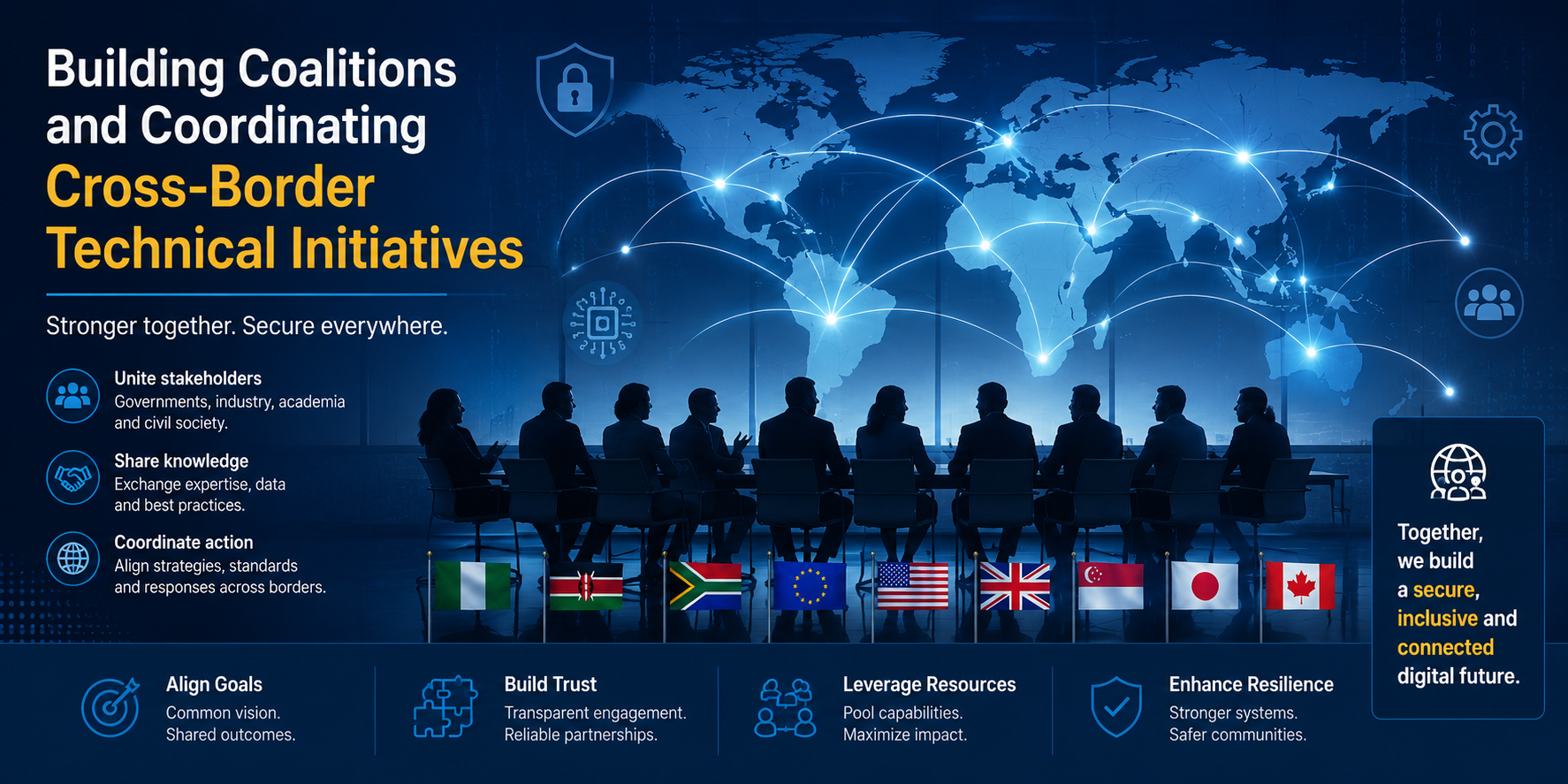
Building Coalitions and Coordinating Cross-Border Technical Initiatives.
Building multi-stakeholder coalitions and steering cross-border technical initiatives is one of the hardest challenges in engineering leadership, inter-governmental policy, and global product delivery.
When working across sovereign boundaries, varied regulatory regimes, and differing technical maturities, you cannot rely on command-and-control leadership. Success hinges on creating alignment through shared incentives, robust governance, and interoperable architectures.
Here is an end-to-end operational framework for building cross-border technical coalitions and bringing them to launch.
Phase 1: Coalition Building & Alignment
Before writing technical specs, you must align incentives across sovereign or organizational entities that may have competing priorities.
       [ Align Incentives ]
                │
                ▼
  [ Technical Governance Model ] ──► Steering Committee + Tech Working Groups
                │
                ▼
  [ Interoperability Strategy ] ──► Standardize Interfaces, Not Internals
1. Identify the “Lowest Common Denominator” Value
-
Align on Shared Pain: Focus on a problem no single country or entity can solve alone (e.g., cross-border payment settlements, shared threat intelligence, transboundary water management, or climate data exchanges).
-
Decouple Tech from Sovereignty: Stakeholders often fear losing national or data sovereignty. Frame the architecture around federated or decentralized systems where each member retains custody of their own data and infrastructure.
2. Establish a Formal Technical Governance Structure
Create a simple, tier-based governance structure to keep decisions moving:
-
Executive Steering Committee (Political / Business Level): Sets strategic goals, secures funding, and unblocks policy or legal deadlocks.
-
Technical Working Group (Engineering Level): Owns API contracts, data schemas, compliance, and integration testing.
-
Architecture Review Board (ARB): Resolves technical disputes, evaluates RFCs (Request for Comments), and maintains the technical roadmap.
Phase 2: Technical Architecture & Standardization
Cross-border systems fail when one party tries to force their legacy tech stack onto everyone else. Focus on interoperability over uniformity.
┌─────────────────────────────────────────────────────────────┐
│                    Federated API Gateway                    │
└──────────────┬──────────────────────────────┬───────────────┘
               │                              │
       ┌───────▼────────┐             ┌───────▼────────┐
       │   Nation /     │             │   Nation /     │
       │ Entity A Stack │             │ Entity B Stack │
       └────────────────┘             └────────────────┘
| Domain | Best Practice Strategy | Key Objective |
| Data Architecture | Adopt schema-first design (e.g., OpenAPI, Protobuf, or ISO standards like ISO 20022). | Decouple internal backend logic from external cross-border data contracts. |
| Compliance & Privacy | Use Data Localization + Zero-Knowledge Architecture. Keep sensitive PII inside local borders; exchange verified cryptographic proofs or tokenized assets. | Comply with disparate data protection laws (e.g., GDPR, local privacy acts). |
| Security & Auth | Implement federated identity protocols (OAuth 2.0 / OIDC, mTLS, or Decentralized Identifiers). | Avoid centralized identity management that creates a single point of political failure or trust. |
Phase 3: Operationalizing & Execution
Execution across time zones, languages, and corporate cultures requires structured, transparent processes.
1. The RFC (Request for Comments) Process
Adopt an asynchronous, text-first engineering process modeled after internet standard bodies (like the IETF or W3C):
-
Draft: A technical proposal is published as an RFC document.
-
Review: Open comment window (e.g., 2–4 weeks) where technical leads from all participating nations offer feedback.
-
Consensus: Move to “Final Call” once major technical objections are addressed.
2. Sandbox-First Development
-
Build a Cross-Border Testbed: Deploy an open, shared sandbox environment populated with synthetic data early in the timeline.
-
Self-Service Onboarding: Allow participating engineering teams to test their endpoints against automated conformance suites before official integration testing.
Key Risk Mitigation Framework
The Goldilocks Principle of Standardization: Standardize only the interfaces (APIs, data formats, protocols), never the internal implementations. Attempting to force every member to use the same cloud provider, database, or programming language will paralyze the coalition.
-
Sovereignty Shock: Member states pull out due to data privacy concerns.
-
Fix: Build zero-trust architectures and local-first data persistence from day zero.
-
-
Asymmetric Technical Capacity: Wealthier or more tech-mature partners move faster, leaving others behind.
-
Fix: Provide reference implementations (open-source starter kits/SDKs) that less-resourced teams can deploy out-of-the-box.
-
-
Scope Creep via Committee: Endless debate over non-essential features.
-
Fix: Enforce a strict “Minimum Viable Interoperability” (MVI) policy for Phase 1.
-
Next Steps & Deep Dives
Depending on where you are in this initiative, we can tailor a framework specific to your current stage:
-
Drafting Governance Agreements: Defining Memorandum of Understanding (MoU) terms or technical charters.
-
Designing the Tech Architecture: Structuring federated data architectures, cross-border API gateways, or compliance-first auth protocols.
-
Engineering Execution: Establishing asynchronous communication protocols (RFC workflows, sandbox environments, and automated conformance testing).