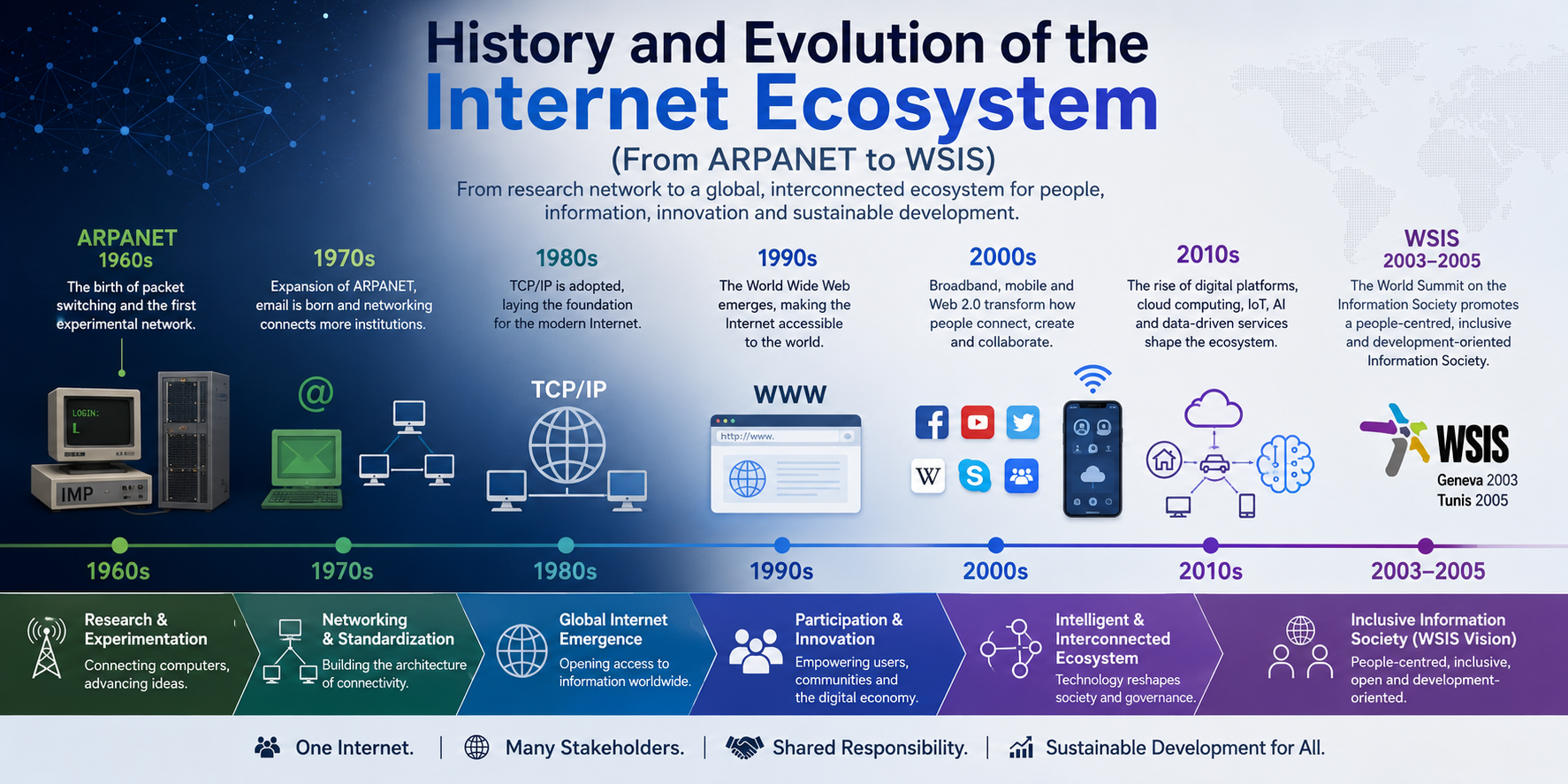
History and Evolution of the Internet Ecosystem (From ARPANET to WSIS).

History and Evolution of the Internet Ecosystem (From ARPANET to WSIS).

The story of the Internet ecosystem is a transition from a small, US-funded military-academic research project into a global, multi-stakeholder governance framework powering society.
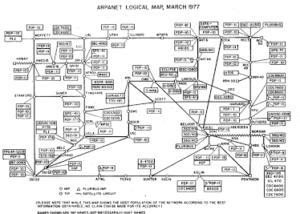
 

Notice how early network nodes like UCLA, Stanford, MIT, and Harvard were interconnected via Interface Message Processors (IMPs) — the predecessors to modern routers.

Historical Progression: From Network Protocol to Global Governance


ARPANET & Packet Switching
1969

Funded by the US Defense Advanced Research Projects Agency (DARPA), ARPANET achieved the first node-to-node communication using packet switching — breaking data into small chunks to send across decentralized routes.


The Adoption of TCP/IP
1983

On January 1, 1983 (“Flag Day”), ARPANET officially switched from NCP to TCP/IP (Transmission Control Protocol / Internet Protocol). This established an open, interoperable standard that allowed separate networks to link together, giving birth to the “Internet.”


Open Engineering & The Web
1986 – 1991

Technical oversight shifted toward community-driven bodies like the IETF (Internet Engineering Task Force). In 1989, Tim Berners-Lee invented the World Wide Web at CERN, releasing HTML, HTTP, and the first browser to the public domain without royalties.


Commercialization & ICANN
1998

As commercial activity boomed, coordination of the Domain Name System (DNS) and IP address allocation moved from government-funded management (Jon Postel’s IANA role) to the newly formed ICANN (Internet Corporation for Assigned Names and Numbers).

 
WSIS & The Multi-Stakeholder Model
2003 – 2005

The UN convened the World Summit on the Information Society in Geneva (2003) and Tunis (2005). WSIS formally defined Internet Governance and established the Internet Governance Forum (IGF), cementing a multi-stakeholder framework where governments, civil society, technical experts, and private sector hold equal seats at the discussion table.


Key Takeaway: The Core Architectural Shift

The evolutionary journey moved through three distinct phases:

  1. Technical Era (1960s–1980s): Focused on protocol standardization, resilience, and open interoperability.

  2. Institutional Era (1990s): Focused on privatizing DNS, managing root servers, and expanding global commercial access.

  3. Policy & Political Era (2000s–Present): Sparked by WSIS, focusing on digital divides, cyber sovereignty, human rights, and distributed governance.