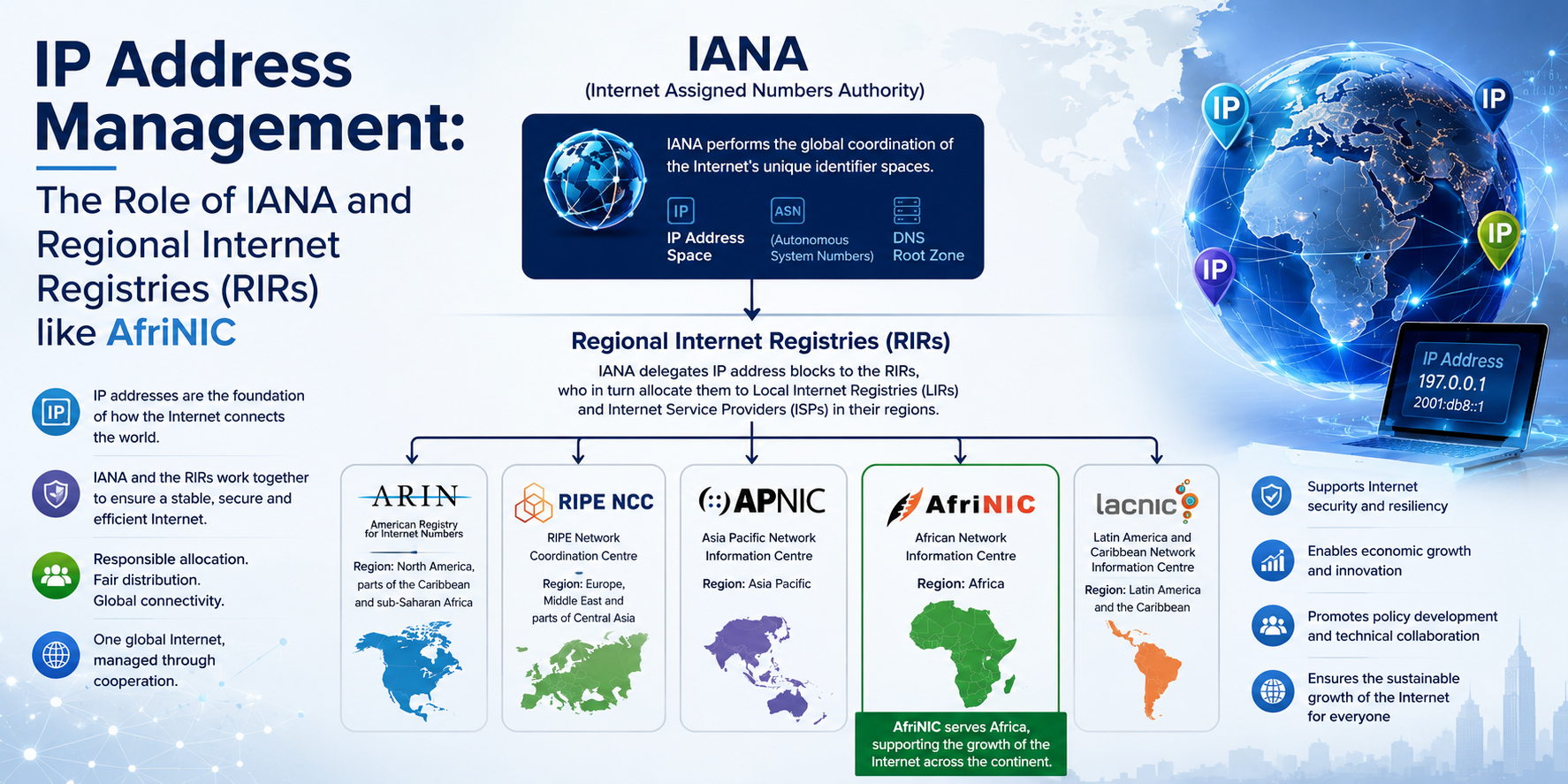
IP Address Management: The Role of IANA and Regional Internet Registries (RIRs) like AfriNIC.
IP Address Management (IPAM) at a global scale ensures that every device connected to the Internet receives a unique numeric identifier (IPv4 or IPv6) and Autonomous System Number (ASN). Without central coordination, IP address duplication would cause routing collisions and break global connectivity.
Global IP address management relies on a hierarchical, multi-stakeholder model spanning three primary tiers:
                  [ IANA / PTI ]
             Global Master Registry
                        │
                        ▼
      [ Regional Internet Registries (RIRs) ]
   AfriNIC  |  APNIC  |  ARIN  |  LACNIC  |  RIPE NCC
                        │
                        ▼
    [ Local Internet Registries (LIRs) / ISPs ]
   Service Providers, Enterprises, Universities
                        │
                        ▼
                   [ End Users ]
1. Top Tier: The Role of IANA
The Internet Assigned Numbers Authority (IANA)—operated by Public Technical Identifiers (PTI), an affiliate of ICANN—serves as the master administrator of the Internet’s global pool of unique identifiers.
-
Bulk Allocation: IANA does not assign IP addresses directly to end users or Internet Service Providers (ISPs). Instead, it allocates large blocks of unallocated IP addresses (e.g.,
/8blocks for IPv4 or/12–/32blocks for IPv6) to the five Regional Internet Registries (RIRs) based on global consensus policies. -
Protocol Parameter Management: Maintains official registries of protocol numbers, port numbers, and root domain zone parameters established by the Internet Engineering Task Force (IETF).
-
Post-Exhaustion Oversight: Manages the return and redistribution of reclaimed IPv4 blocks to RIRs as needed.
2. Regional Tier: Regional Internet Registries (RIRs)
RIRs are non-profit, member-driven organizations responsible for administering and registering IP address space and ASNs within their designated geographical boundaries.
The five global RIRs are:
| RIR | Geographic Coverage | Established |
| AfriNIC | Africa and the Indian Ocean region | 2004 |
| APNIC | Asia-Pacific region | 1993 |
| ARIN | Canada, the United States, and parts of the Caribbean | 1997 |
| LACNIC | Latin America and the Caribbean | 1999 |
| RIPE NCC | Europe, Middle East, and parts of Central Asia | 1992 |
Primary Functions of RIRs
-
Resource Allocation: Distributing IP address blocks and ASNs to Local Internet Registries (LIRs), ISPs, educational institutions, and large enterprises.
-
WHOIS & Routing Registries: Maintaining publicly accessible databases (WHOIS and Internet Routing Registries) that record address ownership and routing policies to combat misuse and facilitate technical troubleshooting.
-
Bottom-Up Policy Development Process (PDP): Hosting open forums where the regional community—engineers, network operators, civil society, and governments—proposes, debates, and adopts policies governing address distribution.
-
Security & Deployment: Promoting secure routing mechanisms like Resource Public Key Infrastructure (RPKI) and driving IPv6 adoption.
3. Spotlight on AfriNIC
Recognized by ICANN in 2005 as the fifth RIR, AfriNIC (African Network Information Centre), based in Mauritius, oversees IP resource allocation across 50+ African nations and island territories.
Core Mission: To deliver professional distribution of Internet number resources, strengthen African Internet self-governance, and foster digital infrastructure growth across the continent.
Key Roles and Responsibilities
-
Sub-Regional Governance: Governed by a board representing six sub-regions (Northern, Western, Central, Eastern, Southern, and Indian Ocean) to prevent regional bias and ensure equitable access.
-
IPv4 Preservation & IPv6 Transition: AfriNIC entered the final phase of IPv4 exhaustion later than other RIRs. It maintains strict management policies for remaining IPv4 pools while leading continent-wide technical training for IPv6 transition.
-
Capacity Building & Fellowship Programs: Runs extensive hands-on workshops, certifications, and fellowship initiatives to train African network engineers in routing security, DNS infrastructure, and network architecture.
-
Routing Security (RPKI): Operates the regional RPKI trust anchor, enabling African network operators to cryptographically sign their BGP route announcements to prevent route hijacking and misconfigurations.
4. Global Coordination: The NRO & ASO
While RIRs operate independently within their respective regions, they coordinate on global issues through two key bodies:
-
Number Resource Organization (NRO): An umbrella entity formed by the five RIRs to unify technical projects, protect unallocated IP address pools, and present a joint voice in global Internet governance forums (like the IGF).
-
Address Supporting Organization (ASO): Established within ICANN to advise the ICANN Board on global IP addressing policies and oversee the election of representatives to ICANN governance roles.