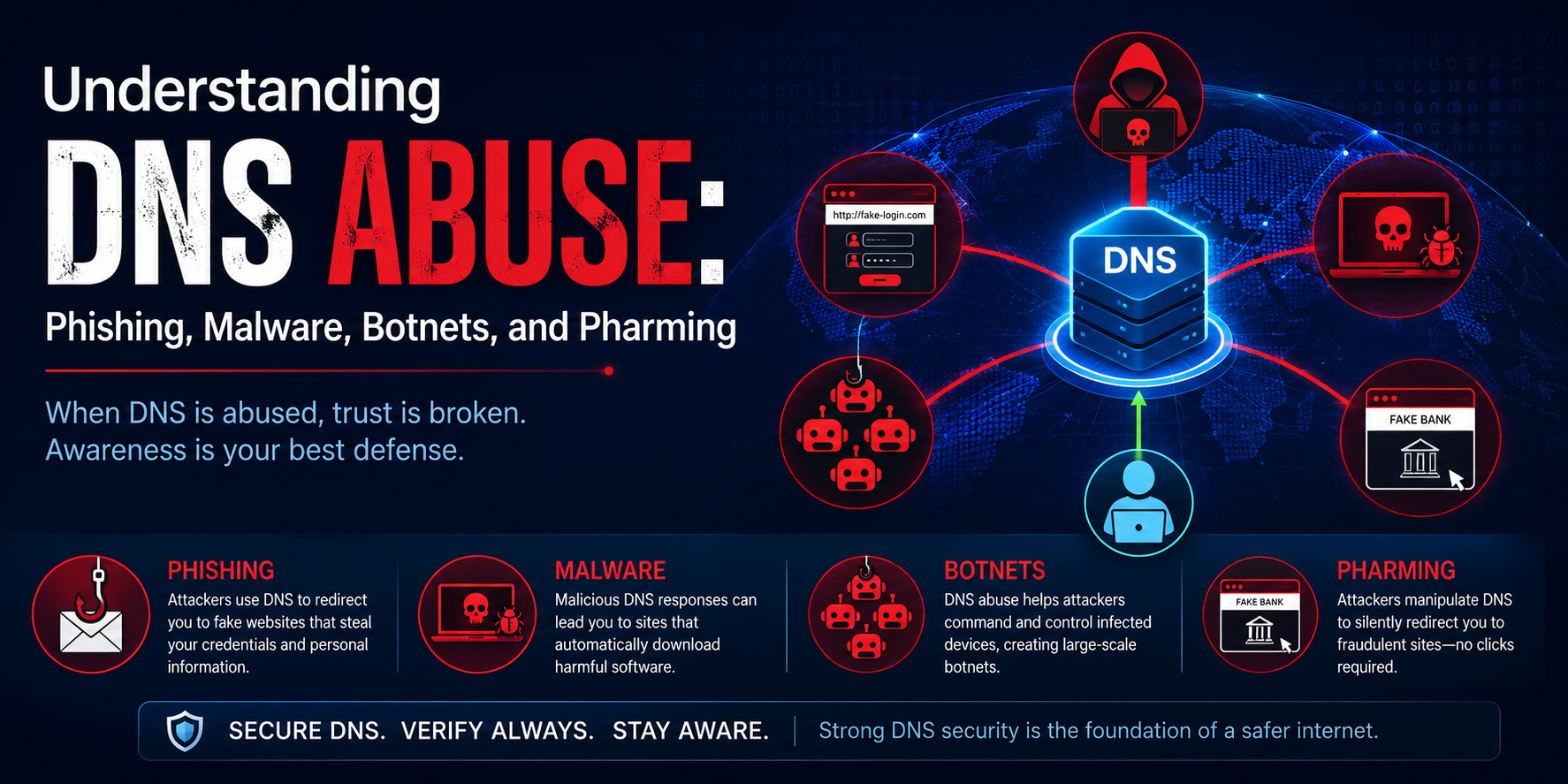
Understanding DNS Abuse: Phishing, Malware, Botnets, and Pharming.
DNS Abuse refers to intentional malicious activity that exploits the Domain Name System (DNS) infrastructure or uses domain names as a primary vector for cyber threats.
In technical governance frameworks (such as ICANN and the DNS Abuse Institute), DNS Abuse is specifically categorized into five core threats: Phishing, Malware, Botnets, Pharming, and Spam (when used to deliver the other four).
The Four Major DNS Abuse Vectors
1. Phishing
-
What it is: A social engineering attack where bad actors create deceptive domain names that imitate legitimate brands, financial institutions, or services.
-
How DNS is used: Attackers register lookalike domains (e.g., using typosquatting like
paypaI.comwith a capitalIinstead ofl) to host fake login portals designed to steal credentials or financial details.
2. Malware Distribution
-
What it is: Malicious software (ransomware, spyware, trojans) designed to compromise systems, steal data, or corrupt files.
-
How DNS is used: Domains serve as delivery points where infected emails, drive-by downloads, or compromise vectors direct victims to download executable malware payloads.
3. Botnets
-
What it is: A network of compromised devices (“bots” or “zombies”) controlled remotely by a central attacker (the bot master) to launch massive Distributed Denial of Service (DDoS) attacks, send spam, or steal data.
-
How DNS is used: Botnet operators use DNS to maintain communication between compromised bots and Command & Control (C2) servers. Techniques include:
-
Domain Generation Algorithms (DGA): Generating hundreds of random domain names daily so bots can find active C2 servers even if security teams block individual domains.
-
Fast-Flux DNS: Rapidly swapping the IP addresses behind a domain name every few seconds to hide the real server location.
-
4. Pharming
-
What it is: A sophisticated redirection attack that sends a user to a fraudulent website even when they type the correct URL into their browser.
-
How DNS is used: Rather than relying on social engineering like phishing, pharming manipulates the DNS lookup process itself:
-
DNS Cache Poisoning: Injecting false DNS records into a recursive resolver so every user querying that resolver gets sent to an attacker-controlled IP.
-
Host File Modification: Malware alters the target’s local system files to resolve legitimate web addresses to malicious IP addresses locally.
-
Quick Comparison
| Threat | Primary Target | Key Mechanism | How Victims Are Caught |
| Phishing | User Credentials | Deceptive URLs / Lookalike domains | Tricked by fake emails or links |
| Malware | System Integrity | Payload delivery via compromised domains | Downloading infected files |
| Botnets | Network Traffic & C2 | DGA / Fast-Flux communication protocols | Device infected in background |
| Pharming | DNS Resolution Path | DNS cache poisoning / Host file hacks | Automatic redirect despite typing true URL |