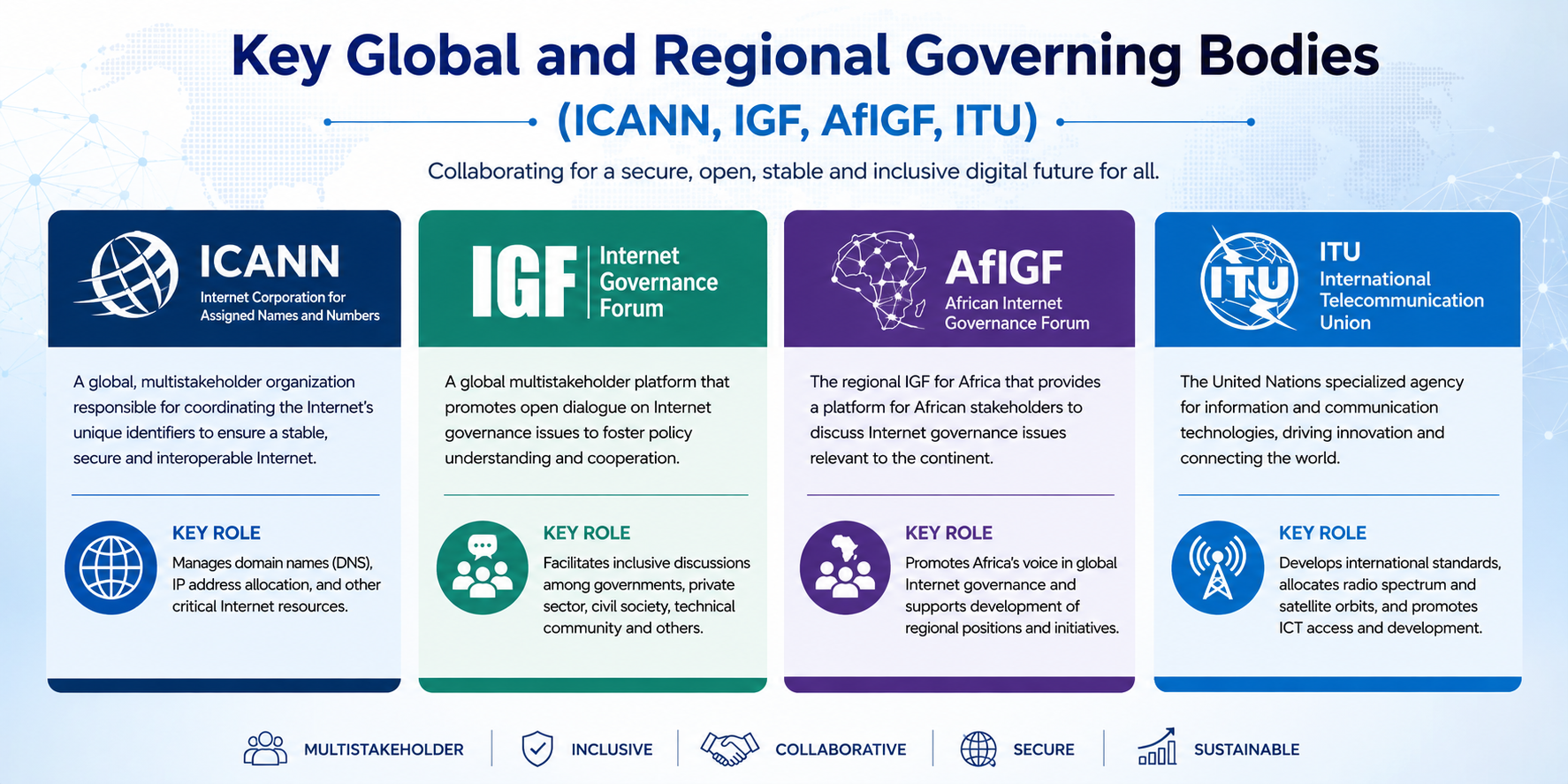
Key Global and Regional Governing Bodies (ICANN, IGF, AfIGF, ITU).
Global and regional internet governance relies on a balance between multistakeholder platforms (where technical experts, civil society, businesses, and governments participate as peers) and multilateral institutions (traditionally run directly by governments).
The primary roles, operating models, and key functions of ICANN, IGF, AfIGF, and ITU form the structural framework of global and regional governance.
Technical vs. Policy Governance Landscape
                     ┌──────────────────────────────────────────────┐
                     │          GLOBAL DIGITAL ECOSYSTEM            │
                     └──────────────────────┬───────────────────────┘
                                            │
           ┌────────────────────────────────┴────────────────────────┐
           ▼                                                         ▼
┌───────────────────────┐                               ┌───────────────────────┐
│ Multistakeholder Model│                               │  Multilateral Model   │
│ (Technical & Policy)  │                               │    (Governmental)     │
└──────────┬────────────┘                               └───────────┬───────────┘
           │                                                        │
 ┌─────────┴────────────┬────────────────────────┐                  │
 ▼                      ▼                        ▼                  ▼
ICANN                  IGF                     AfIGF               ITU
(Technical Coordinator)(Global Dialogue)    (Regional Dialogue) (Intergovernmental Standards)
Governing Bodies Breakdown
1. ICANN (Internet Corporation for Assigned Names and Numbers)
-
Scope: Global
-
Model: Bottom-up Multistakeholder Model
-
Role: Technical Coordinator
-
Primary Focus:
-
Coordinates the Domain Name System (DNS), Internet Protocol (IP) address allocation, and root server system management via the IANA (Internet Assigned Numbers Authority) functions.
-
Sets policy for top-level domains (gTLDs like
.comor.org, and IDNs for internationalized scripts).
-
-
Key Characteristic: Highly functional and operational. ICANN creates binding technical policies for domain registries and registrars, but does not regulate online content or internet law.
2. IGF (Internet Governance Forum)
-
Scope: Global
-
Model: Multistakeholder Dialogue Platform (UN-convened)
-
Role: Policy Discussion & Capacity Building
-
Primary Focus:
-
Establishes a neutral space for governments, civil society, technical experts, and academia to discuss emerging internet issues (e.g., AI ethics, cybersecurity, digital rights, data privacy).
-
Formed as an outcome of the World Summit on the Information Society (WSIS) in 2005.
-
-
Key Characteristic: Non-decisional. The IGF does not issue legally binding treaties or policies; instead, it shapes international norm-setting and informs decisions made by other national or global bodies.
3. AfIGF (Africa Internet Governance Forum)
-
Scope: Regional (Africa)
-
Model: Regional Multistakeholder Initiative
-
Role: Regional Policy Alignment & Capacity Building
-
Primary Focus:
-
Serves as the primary continental platform to address Africa-specific digital priorities—such as closing connectivity gaps, promoting Universal Acceptance (UA), boosting local internet exchange points (IXPs), and developing regional cybersecurity frameworks.
-
Connects national/sub-regional forums (like WAIGF or SAIGF) to the global IGF stage.
-
-
Key Characteristic: Specialized sub-tracks, such as the African School on Internet Governance (AfriSIG) and the Parliamentary Track, specifically build policy capacity for regional leaders and parliamentarians.
4. ITU (International Telecommunication Union)
-
Scope: Global
-
Model: Multilateral / Intergovernmental (UN Specialized Agency)
-
Role: Telecommunications Standards & Infrastructure
-
Primary Focus:
-
Coordinates global radio-frequency spectrum allocation and satellite orbits.
-
Develops worldwide technical telecommunication standards (ITU-T).
-
Drives global telecommunication development initiatives (ITU-D) to expand access in developing countries.
-
-
Key Characteristic: Treaty-based. Decisions are driven primarily by UN Member State votes rather than consensus across non-governmental stakeholders.
Quick Comparison Matrix
| Governing Body | Scope | Governance Model | Key Deliverable | Binding Power? |
| ICANN | Global | Multistakeholder | Technical DNS/IP policies & registrar contracts | Yes (within technical remit) |
| IGF | Global | Multistakeholder | Policy outputs, best practices, networks | No (Informational/Normative) |
| AfIGF | Regional (Africa) | Multistakeholder | Continental consensus briefs & policy guidance | No (Informational/Normative) |
| ITU | Global | Intergovernmental | International treaties, spectrum allocation, standards | Yes (for member states via treaties) |