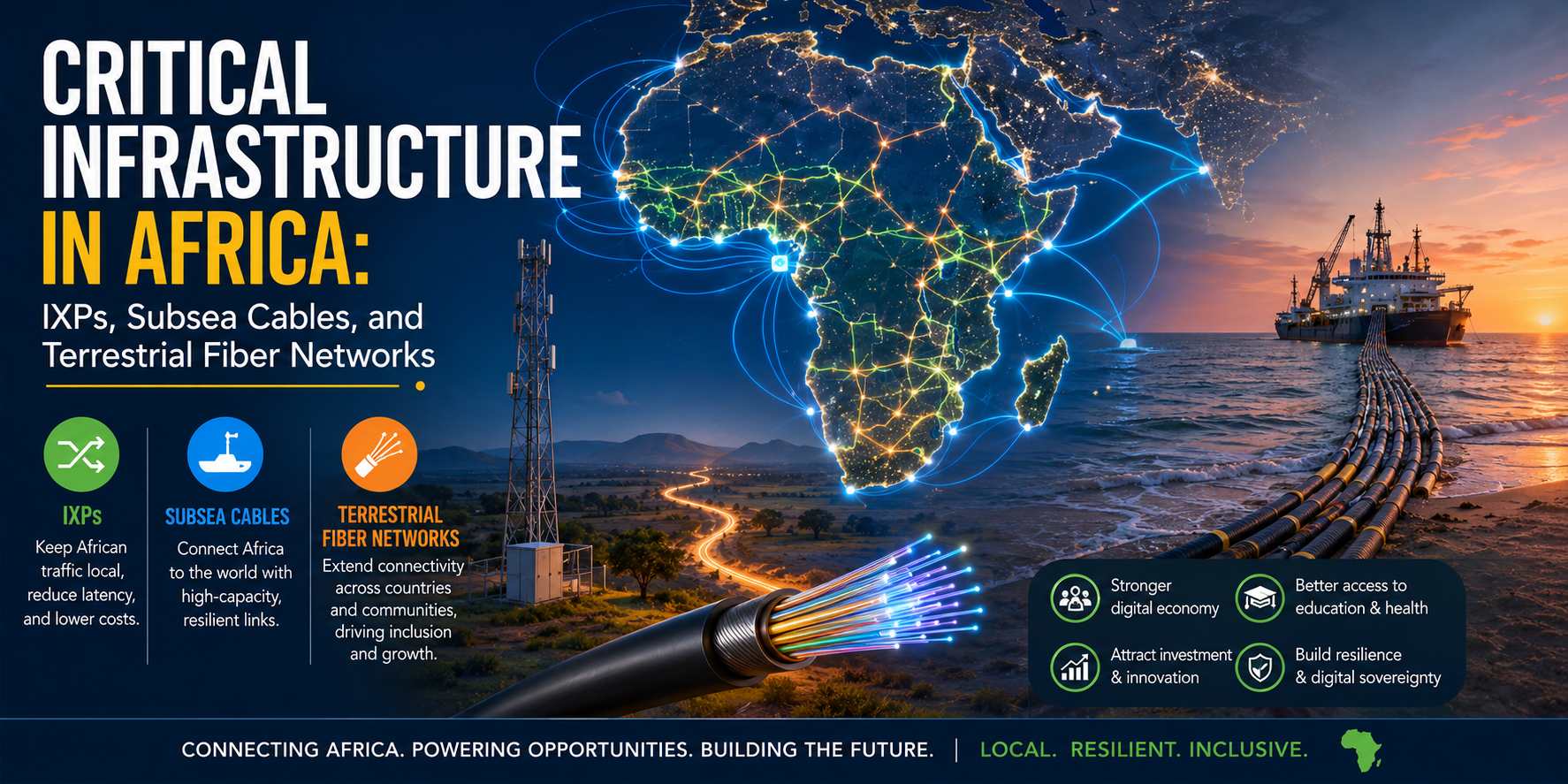
Critical Infrastructure in Africa: IXPs, Subsea Cables, and Terrestrial Fiber Networks.
Africa’s digital economy relies on three foundational, mutually dependent physical layers: Subsea Cables, Terrestrial Fiber Networks, and Internet Exchange Points (IXPs).
Together, these three components determine the resilience, cost, latency, and sovereignty of data flows across the continent.
1. Subsea Cables: The Global Gateways
Subsea fiber-optic cables carry over 95% of Africa’s international data traffic, serving as the primary digital links between Africa and the global internet.
+-----------------------------------------------------------------+
|                      GLOBAL INTERNET HUB                        |
+-----------------------------------------------------------------+
                                |
                   (Subsea Fiber Optic Cables)
                                |
                                v
+-----------------------------------------------------------------+
|                    COASTAL LANDING STATIONS                     |
+-----------------------------------------------------------------+
                                |
             (Cross-Border & National Terrestrial Fiber)
                                |
                                v
+-----------------------------------------------------------------+
|                  INTERNET EXCHANGE POINTS (IXPs)                |
|                    & LOCAL DATA CENTRES                         |
+-----------------------------------------------------------------+
Key Trends & Deployments
-
Next-Generation Mega-Cables: High-capacity systems such as Meta’s 2Africa (encircling the continent) and Google’s Equiano (running along the West Coast to South Africa) have increased international bandwidth.
-
Open-Access Models: Modern subsea systems prioritize open-access landings to prevent single-carrier monopolies and drive down wholesale data costs.
Critical Vulnerabilities & Risks
-
Single Points of Failure: Subsea cuts—caused by seismic activity, undersea landslides, or ship anchors—frequently lead to service disruptions across multiple nations.
-
Chokepoint Reliance: Coastal countries with a single landing station face severe isolation during repairs, highlighting the need for redundant landing locations.
2. Terrestrial Fiber Networks: The Internal Arteries
While subsea cables bring capacity to coastlines, terrestrial fiber networks distribute that bandwidth inland to urban centers, landlocked nations, and rural communities.
[ Coastal Cable Landing ]
           │
           ├──> (National Backbone Fiber) ──> [ Metropolitan Ring ] ──> End User
           │
           └──> (Cross-Border Terrestrial Fiber) ──> [ Landlocked Country IXP ]
Core Functions & Architecture
-
Landlocked Access: Landlocked nations (e.g., Ethiopia, Rwanda, Zambia) rely entirely on cross-border terrestrial transit agreements with coastal neighbors to connect to global networks.
-
Utility Infrastructure Integration: Telecom operators leverage existing rights-of-way—along power grids, railways, and highways—to accelerate backbone deployment.
Bottlenecks & Strategic Gaps
-
Cross-Border Harmonization: Regulatory misalignment, complex transit tariffs, and customs hurdles between adjacent countries frequently delay cross-border fiber links.
-
Physical Security: Aerial and shallow-buried inland fiber cables remain vulnerable to road construction cuts, vandalism, and environmental disruption.
3. Internet Exchange Points (IXPs): Keeping Local Traffic Local
An Internet Exchange Point (IXP) is physical infrastructure where Internet Service Providers (ISPs), Content Delivery Networks (CDNs), and enterprise networks exchange traffic locally.
 WITHOUT LOCAL IXP:                              WITH LOCAL IXP:
[ISP A (Lagos)]                                 [ISP A (Lagos)]
      │                                                │
  (Subsea Cable)                                       ▼
      │                                       ┌─────────────────┐
      ▼                                       │   LOCAL IXP     │
[Server (Europe)] ──> [ISP B (Lagos)]         │  (Keeps traffic │
  High Latency & High Transit Cost            │     in-country)   │
                                              └─────────────────┘
                                                       ▲
                                                       │
                                                [ISP B (Lagos)]
                                           Low Latency & Zero Transit Fee
The “Tromboning” Problem
Historically, an email sent between two neighboring African cities was routed through European servers before returning, causing high latency and inflated international transit costs.
Impact of IXPs
-
Latency Reduction: Routing local traffic locally reduces round-trip times from hundreds of milliseconds to under 10ms.
-
Cost Savings: Keeping intra-regional traffic local conserves expensive international subsea capacity.
-
Regional Hubs: Major IXPs (such as NAPAfrica in Johannesburg, JIXP in Nairobi, and IXPN in Lagos) have evolved into interconnection ecosystems hosting global cloud providers, edge caching servers, and local fintech infrastructure.
Structural Comparison
| Infrastructure Layer | Primary Role | Key Strategic Risks | Core Objective |
| Subsea Cables | High-capacity international transit | Anchors, seismic damage, landing point reliance | Connect Africa to global data hubs |
| Terrestrial Fiber | Inland transport & cross-border transit | Fiber cuts, rights-of-way costs, cross-border tariffs | Bridge the coastal-inland digital divide |
| IXPs | Local/regional traffic exchange | Policy friction, lack of local content caching | Retain local traffic and reduce latency |
Key Strategic Priorities
-
Infrastructure Redundancy: Developing mesh-networked terrestrial paths ensures that if one subsea cable fails, traffic can automatically re-route via alternative coastal landings.
-
Open-Access Data Centers & IXPs: Expanding Tier III and IV data centers alongside neutral IXPs encourages major content providers to store data locally, improving security and performance.
-
Cross-Border Regulatory Harmonization: Streamlining regional licensing, cross-border fiber clearance, and transit pricing creates a single digital market across the continent.