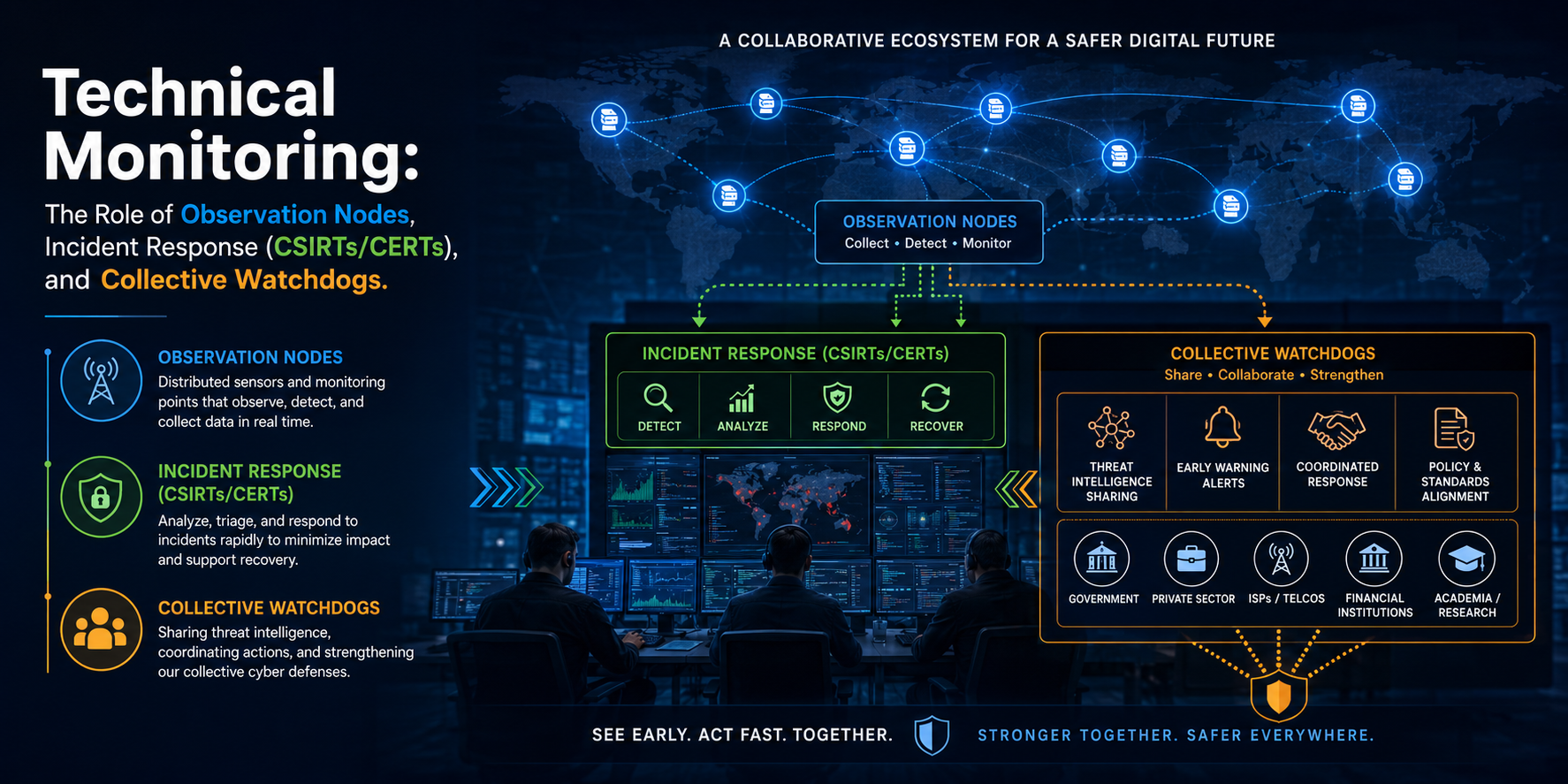
Technical Monitoring: The Role of Observation Nodes, Incident Response (CSIRTs/CERTs), and Collective Watchdogs.
Technical monitoring across the internet ecosystem relies on a three-tier architecture: Observation captures raw telemetry, Operational Response mitigates active threats, and Watchdogs aggregate intelligence to hold infrastructure providers accountable.
1. Observation Nodes: The Telemetry Foundation
Observation nodes act as the primary sensors across networks, collecting structured telemetry to detect anomalies, malware, and technical abuse (e.g., DNS abuse, phishing, DDoS origin points).
-
Passive DNS (pDNS) Sensors: Capture DNS resolution data at recursive resolvers to identify fast-flux domains, newly registered malicious hostnames, and domain generation algorithms (DGAs).
-
Honeypots & Darknets: Deploy unallocated IP spaces or vulnerable services to capture unauthorized scanning, brute-force activity, and automated exploit payloads.
-
Border Gateway Protocol (BGP) Route Monitors: Trace routing announcements across Autonomous Systems (ASNs) to detect BGP hijacking, route leaks, and traffic redirection attempts.
-
NetFlow/IPFIX Collectors: Monitor flow metadata at exchange points (IXPs) and ISP transit interfaces to detect volume anomalies, botnet command-and-control (C2) traffic, and amplification attacks.
2. Incident Response (CSIRTs & CERTs): Operational Triage & Mitigation
Computer Security Incident Response Teams (CSIRTs) and Computer Emergency Response Teams (CERTs) translate raw telemetry into structured containment, remediation, and operational coordination.
Core Responsibilities
-
Ingestion & Standardized Exchange: Ingest raw Indicators of Compromise (IoCs) and convert them into machine-readable threat intelligence using protocols like STIX/TAXII or MISP.
-
Triage & Attribution: Correlate telemetry from observation nodes to verify true positives, assess impact severity, and group related infrastructure into threat actor profiles.
-
Takedown & Containment: Issue formal abuse notifications to registrars, registries, hosting providers, or upstream ASNs to suspend malicious domains, block IP ranges, or sinkhole malicious traffic.
-
Cross-Border Coordination: Coordinate via international coalitions (e.g., FIRST, APCERT) when attacks cross jurisdictional and organizational boundaries.
3. Collective Watchdogs: Strategic Governance & Systemic Accountability
While CSIRTs handle point-in-time operational incidents, collective watchdogs (e.g., Shadowserver Foundation, Spamhaus, DNS Abuse Institute, Global Cyber Alliance) focus on ecosystem-level oversight and systemic threat suppression.
-
Aggregated Telemetry & Feeds: Collect, sanitize, and enrich data from global observation nodes to produce high-confidence blocklists and threat intelligence feeds.
-
Registrar & Registry Accountability: Track technical abuse concentration across top-level domains (TLDs) and hosting providers, publishing compliance benchmarks to incentivize proactive mitigation.
-
Free Remediation Data: Distribute actionable, network-specific threat reports directly to network operators and national CERTs to clean up infected endpoints globally.
Comparative Ecosystem Roles
| Layer | Primary Objective | Data / Tools | Output / Deliverable |
| Observation Nodes | Detect raw network events | pDNS, NetFlow, Honeypots, BGP feeds | Raw logs, packet captures, telemetry streams |
| CSIRTs / CERTs | Contain active incidents | SIEM, MISP, STIX/TAXII, forensic suites | Takedown requests, advisories, patch guidance |
| Collective Watchdogs | Aggregate & enforce oversight | Global sensor networks, reputation scoring | Blocklists, registry benchmarks, policy insights |