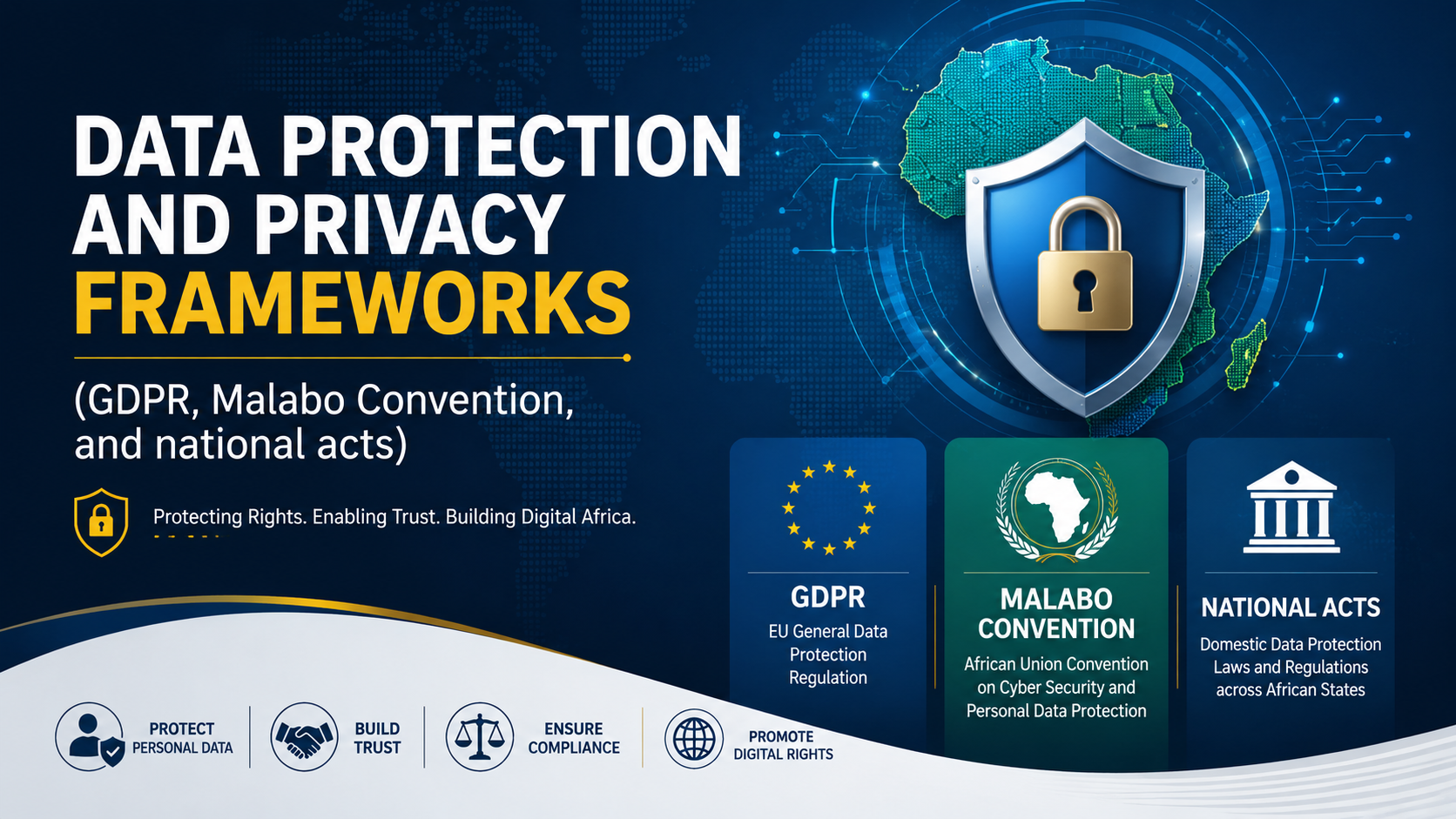
Data Protection and Privacy Frameworks (GDPR, Malabo Convention, and national acts).
Modern data governance is shaped by a layered ecosystem of regional frameworks, continental conventions, and domestic statutes. Understanding how these mechanisms interact is crucial for managing cross-border data flows, regulatory compliance, and individual digital rights.
Here is a side-by-side analysis of the primary frameworks and how national acts implement them.
1. Regulatory Overview
| Dimension | GDPR (European Union) | Malabo Convention (African Union) | National Acts (e.g., NDPA, POPIA, Kenya DPA) |
| Legal Nature | Directly applicable regulation across all EU Member States. | Continental framework treaty; requires domestic enacting legislation. | Primary domestic statutes enacted by sovereign parliaments. |
| Jurisdictional Scope | Extraterritorial: Applies to any entity worldwide targeting EU residents. | Territorial: Applies to processing within signatory AU state territories. | National Jurisdiction: Applies to local controllers/processors or data collected locally. |
| Status / Force | In effect since May 2018. | Passed in 2014; entered into force June 8, 2023. | Varies (e.g., South Africa POPIA 2020, Nigeria NDPA 2023). |
| Enforcement Mechanism | National Data Protection Authorities (DPAs) + European Data Protection Board (EDPB). | Mandates state parties to establish independent DPAs. | Dedicated national regulatory authorities (e.g., Nigeria’s NDPB/NDPC, Kenya’s ODPC). |
| Penalties | Up to €20M or 4% of global annual turnover. | Direct penalty structures defined by domestic laws of state parties. | Fixed fines, percentage of annual turnover, or imprisonment for executives. |
2. Key Framework Breakdown
A. The General Data Protection Regulation (GDPR)
The GDPR serves as the global “gold standard” for privacy governance. Its structure emphasizes individual autonomy, strict accountability, and heavy penalties for non-compliance.
-
Core Principles: Lawfulness, fairness, transparency, purpose limitation, data minimization, accuracy, storage limitation, and integrity/confidentiality.
-
Key Mechanisms: Mandates Data Protection Impact Assessments (DPIAs) for high-risk processing, explicit provisions for algorithmic transparency, and mandatory 72-hour breach notifications.
B. The Malabo Convention (AU Convention on Cyber Security and Personal Data Protection)
Adopted in 2014 and officially entering into force in June 2023 after reaching 15 ratifications, the Malabo Convention provides a unified African blueprint for digital trust.
-
Triple Focus: Uniquely integrates personal data protection, electronic transactions (e-commerce), and cybersecurity/cybercrime within a single treaty.
-
Continental Vision: Seeks to balance individual privacy rights with state security imperatives and the economic necessity of harmonized cross-border data flows across the African Continental Free Trade Area (AfCFTA).
C. National Acts & Regional Convergence
Domestic statutes operationalize these higher-level treaties into enforceable ground-level rules.
-
Adaptation of Principles: Modern national acts (such as South Africa’s POPIA, Nigeria’s NDPA, or Kenya’s Data Protection Act) blend GDPR-style strict enforcement mechanisms with the regional priorities mapped out in the Malabo Convention and regional economic community frameworks (e.g., ECOWAS Supplementary Act).
-
Data Localization vs. Transfers: National acts frequently introduce nuance regarding cross-border transfers—requiring adequate protections in destination countries, explicitly relying on adequacy decisions, standard contractual clauses (SCCs), or explicit data subject consent.
3. Structural Comparison of Core Elements
                   ┌─────────────────────────────────────────────────┐
                   │               GLOBAL STANDARDS                  │
                   │           (GDPR Influence & Rights)             │
                   └────────────────────────┬────────────────────────┘
                                            │
                                            ▼
                   ┌─────────────────────────────────────────────────┐
                   │              REGIONAL FRAMEWORKS                │
                   │     (Malabo Convention / ECOWAS Directives)     │
                   └────────────────────────┬────────────────────────┘
                                            │
                                            ▼
                   ┌─────────────────────────────────────────────────┐
                   │                 NATIONAL ACTS                   │
                   │        (Enforced by National DPAs)              │
                   └─────────────────────────────────────────────────┘
Data Subject Rights Spectrum: Across GDPR, Malabo, and modern national acts, individuals generally hold core rights including access, rectification, erasure (“right to be forgotten”), object to processing, and data portability.
4. Operational Challenges & Emerging Dynamics
-
Jurisdictional Conflicts: Organizations operating globally face friction between GDPR’s extraterritorial reach and national data sovereignty/localization rules enforced by domestic acts.
-
DPA Capacity: While GDPR DPAs possess mature enforcement mechanisms, many DPAs established under newer national acts following Malabo ratification are still building technical capacity and operational independence.
-
AI & Automated Processing: Newer national implementations are updating regulations to address artificial intelligence, biometric data collection, and automated decision-making—building upon GDPR Article 22 principles.