
Freedom of Expression, Content Regulation, and Managing Online Misinformation/Disinformation.
Balancing freedom of expression with the need for content regulation to tackle online misinformation and disinformation is one of the defining legal, technological, and democratic challenges of our time.
At its core, this issue boils down to a fundamental tension: How do we protect public health, national security, and democratic integrity without turning governments or tech giants into arbitrary “truth police”?
1. Core Terminology: Setting the Stage
To regulate content effectively, legal systems and platforms first differentiate between three key concepts:
-
Misinformation: False or misleading information shared without malicious intent (e.g., someone forwarding a debunked health tip thinking it helps a friend).
-
Disinformation: False or manipulated information created and distributed deliberately to cause public harm, manipulate elections, or generate profit (e.g., state-sponsored propaganda, deepfake hoaxes).
-
Malinformation: Factually accurate information used out of context or leaked deliberately to cause harm (e.g., targeted doxxing, releasing private medical records).
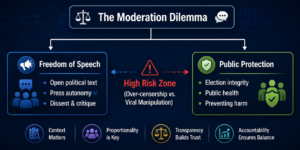
2. The Fundamental Conflict
-
Democracy thrives on open debate: Under international human rights law (such as Article 19 of the Universal Declaration of Human Rights), freedom of expression includes the right to hold opinions and to seek, receive, and impart information.
-
The “Chilling Effect”: If state authorities punish people for publishing false claims, citizens and journalists may self-censor legitimate, critical opinions out of fear.
-
Government Overreach: Granting politicians or regulators the power to define what is “factually true” creates an immediate risk of authoritarian weaponization against political dissidents.
The Regulation Perspective (Preventing Harm)
-
Amplification & Velocity: Algorithms designed to maximize engagement naturally prioritize outrage, sensationalism, and viral hoaxes over slow, factual reporting.
-
National & Public Safety: Intentional disinformation campaigns have disrupted public health efforts, fueled ethnic violence, and undermined democratic elections around the globe.
3. Regulatory Frameworks: Major Global Models
Different jurisdictions take radically different legal paths to handle online content moderation:
| Region / Model | Legal Strategy | Focus | Free Speech Risk |
| United States (First Amendment & Sec. 230) | High speech protection. Private platforms moderate based on Terms of Service, shielded from liability for user content. | Protecting citizens from government censorship. | High tolerance for toxic/false speech; reliance on private corporate discretion. |
| European Union (Digital Services Act / AI Act) | Systemic risk-based regulation. Mandates platform transparency, algorithm audits, and swift removal of illegal content. | Holding mega-platforms accountable for algorithmic harm. | Risk of platforms over-removing gray-area speech to avoid massive fines. |
| Authoritarian / State-Controlled | Broad anti-fake news laws criminalizing vague “false statements”. | Regulating narrative control & state security. | Extreme; routinely weaponized to silence journalists and opposition. |
4. Balanced Strategies for Managing Disinformation
Rather than relying purely on blunt content takedowns—which often backfire or trigger claims of censorship—experts, researchers, and human rights bodies advocate for a multi-layered approach:
A. Algorithmic Friction & Product Design
Instead of deleting posts (deplatforming), platforms can modify product mechanics:
-
Demotions & Friction: Reducing the algorithmic reach of unverified viral links, adding warnings, or limiting forward/share limits (as WhatsApp did to curb mob violence).
-
De-monetization: Removing ad revenue from sites and creators that profit from clickbait hoaxes.
B. Transparency & Procedural Due Process
-
Independent Oversight: Establishing external appeal boards and independent researchers to audit platform decisions.
-
Clear Terms of Service: Ensuring rules are transparently defined, consistently enforced, and offer users a clear path to appeal erroneous removals.
C. Digital Literacy & Inoculation (“Prebunking”)
-
Rather than censoring bad information after it spreads, psychological inoculation (teaching the public to identify common manipulative tactics like emotional manipulation and fake experts) builds long-term societal resilience.