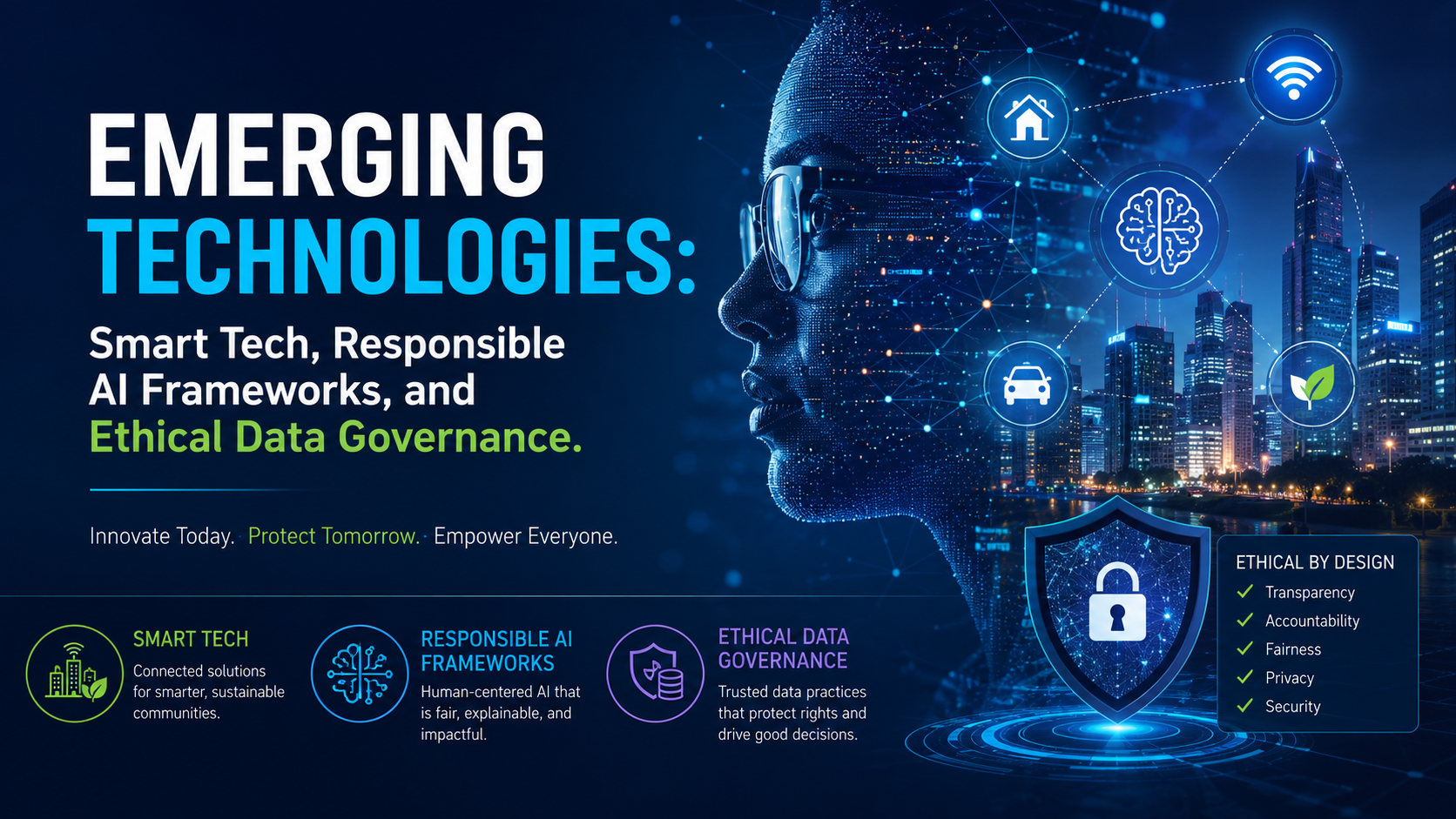
Emerging Technologies: Smart Tech, Responsible AI Frameworks, and Ethical Data Governance.
The intersection of smart technology, responsible AI frameworks, and ethical data governance represents one of the most vital frontiers in modern digital policy and systems architecture. As interconnected systems—from Internet of Things (IoT) sensors and edge devices to sophisticated foundation models—become embedded in daily operations, the need for robust ethical guardrails is no longer optional; it is a foundational imperative for building sustainable public and organizational trust.
1. Smart Tech: The Edge of Emerging Capabilities
Smart technologies integrate hardware, real-time sensing, and intelligent processing to automate environments and optimize decision-making.
-
Pervasive Data Capture: Connected devices (smart grids, urban IoT sensors, wearable diagnostics) collect continuous streams of granular, localized data.
-
Edge Computing & Real-Time Processing: Shift from centralized cloud processing to localized, low-latency computing at the device level, altering how data privacy boundaries are drawn.
-
Autonomous Operational Loops: Systems increasingly act without human-in-the-loop oversight, elevating the technical stakes for reliability, safety, and operational fail-safes.
2. Responsible AI Frameworks: From Principles to Practice
High-level ethical guidelines are essential, but the industry focus has shifted to operationalizing these principles across the software development lifecycle (SDLC).
┌─────────────────────────────────────────────────────────┐
│              RESPONSIBLE AI GOVERNANCE                  │
├───────────────┬─────────────────┬───────────────────────┤
│   Fairness    │  Explainability │     Accountability    │
│  & Non-Bias   │   & Auditability│     & Oversight       │
└───────┬───────┴────────┬────────┴───────────┬───────────┘
        │                │                    │
        ▼                ▼                    ▼
┌───────────────┐┌────────────────┐┌────────────────────┐
│ Diverse Data  ││ Model Cards &  ││ Risk Tiers & Human │
│ Testing & LIME││ Decision Logs ││ In-The-Loop Checks │
└───────────────┘└────────────────┘└────────────────────┘
Core Architectural Pillars
-
Fairness & Non-Discrimination: Implementing continuous bias auditing using metrics like Disparate Impact or Demographic Parity to prevent historical biases from being reinforced in algorithmic outcomes.
-
Explainability & Transparency (XAI): Utilizing local surrogates (e.g., LIME or SHAP values) and structured Model Cards to ensure that automated predictions—especially in high-stakes domain settings like credit, health, or public services—can be audited and explained.
-
Safety & Risk-Based Tiers: Aligning system risk with regulatory structures like the EU AI Act (spanning Unacceptable, High, Limited, and Minimal risk classifications) or the NIST AI Risk Management Framework (AI RMF).
3. Ethical Data Governance: The Structural Foundation
Responsible AI and smart tech are inherently limited by the quality and stewardship of their underlying data. Ethical data governance creates the guardrails that prevent misuse and maintain system integrity.
| Governance Dimension | Core Objective | Key Technical Implementation |
| Data Provenance & Lineage | Trace data origin, transformations, and chain-of-custody across the pipeline. | Immutable metadata logging, cryptographic verification. |
| Privacy Preservation | Protect individual identity while maintaining statistical utility for model training. | Differential Privacy, Federated Learning, and Homomorphic Encryption. |
| Universal Accessibility & Acceptance | Ensure data structures and localized interfaces accommodate global standards and diverse user bases. | Multilingual dataset representation, Internationalized Domain Name (IDN) compatibility, and inclusive data taxonomy design. |
| Data Sovereignty & Minimization | Ensure compliance with regional data residency laws and collect only strictly necessary metrics. | Zero-Trust architecture, automated data-retention lifecycle rules. |
4. Key Implementation Challenges
-
The “Black Box” Dilemma: Balancing the raw predictive performance of complex deep learning architectures with the necessity for human readability and legal compliance.
-
Regulatory Divergence: Navigating a fragmented global compliance ecosystem (e.g., EU AI Act, regional privacy laws, voluntary international codes of conduct).
-
Data Scarcity & Representative Bias: Building intelligent systems in environments where local language, demographic, or technical datasets are underrepresented.
Key Takeaway: True technological sustainability lies at the intersection of these three domains: Smart Tech provides the capabilities, Responsible AI Frameworks direct the reasoning, and Ethical Data Governance secures the foundational integrity.