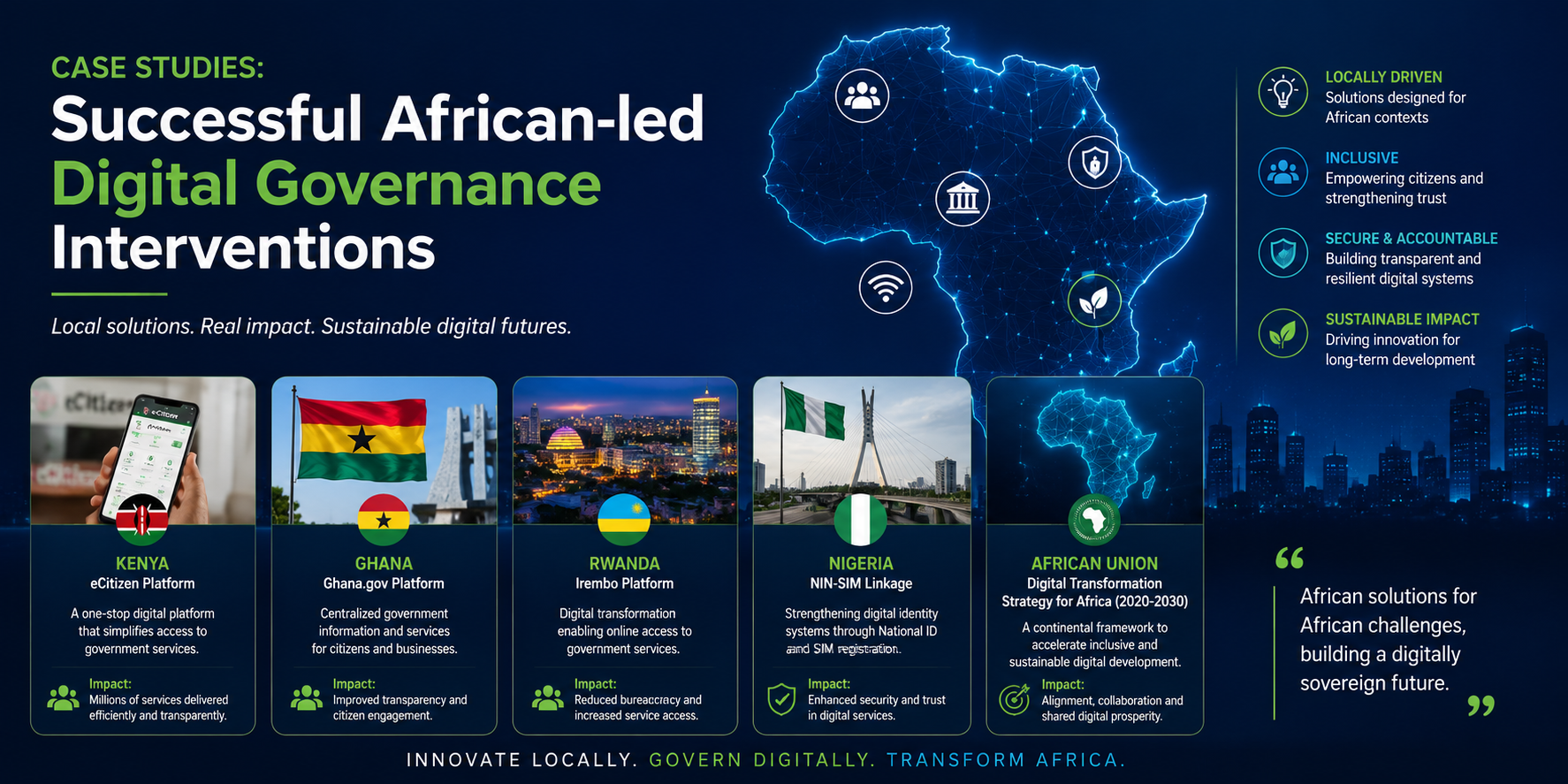
Case Studies: Successful African-led Digital Governance Interventions.
Across the African continent, digital governance is shifting away from reliance on imported external models toward homegrown, tailored innovations designed for local context. These solutions tackle historic challenges around bureaucratic friction, financial exclusion, tax collection efficiency, and public corruption.
Here are four standout case studies of successful, African-led digital governance interventions:
1. Rwanda: IremboGov
-
Core Problem: Fragmented public service delivery requiring in-person visits, physical documentation, long wait times, and vulnerability to petty corruption.
-
The Solution: Launched in 2015, IremboGov is a single-window digital portal created through a public-private partnership between the Rwandan government and Irembo, a domestic tech firm. It digitizes over 100 public services across 20+ government agencies—ranging from applying for birth certificates and land transfers to driving licenses and passports.
-
Why It Worked:
-
Offline Accessibility: Recognizing the digital divide, Irembo scaled an offline agent model (“Irembo Agents”) in rural areas so citizens without internet or smartphones could still access services locally.
-
cashless Operations: Built-in mobile money (MTN MoMo, Airtel Money) integration removed cash handling, virtually eliminating bribery at service desks.
-
2. Kenya: Huduma Kenya & Integrated Service Delivery
-
Core Problem: Siloed government ministries, causing citizens to travel to multiple offices for basic identification, licensing, and civil registration.
-
The Solution: Established under Kenya’s Vision 2030, Huduma Kenya combines physical “one-stop-shop” service centers with a unified digital web portal and mobile platform. It centralizes over 5,000 public services, including national IDs, police clearance certificates, business registrations, and driver’s licenses under a single system architecture.
-
Why It Worked:
-
Hybrid Public Architecture: It meets citizens where they are by pairing high-tech online services with accessible physical touchpoints in rural and urban centers nationwide.
-
Citizen-Centric Focus: Built-in feedback loops and performance tracking hold civil servants accountable to fixed service timelines.
-
3. Nigeria: Treasury Single Account (TSA) & IPPIS
-
Core Problem: Millions of dollars in revenue leakage due to commercial bank accounts maintained by individual government agencies without oversight, alongside thousands of “ghost workers” on state payrolls.
-
The Solution: The federal government mandated a unified Treasury Single Account (TSA) integrated with Remita (a home-grown payment gateway built by SystemSpecs) alongside the Integrated Personnel and Payroll Information System (IPPIS).
-
Why It Worked:
-
Revenue Visibility: TSA consolidated thousands of isolated bank accounts into a central view at the Central Bank of Nigeria, saving billions of dollars in commercial bank fees and preventing revenue diversion.
-
Payroll Transparency: IPPIS integrated biometric verification, eliminating over 70,000 fraudulent “ghost workers” and saving the state billions of Naira annually.
-
4. Zambia: ZIAMIS (Agriculture E-Voucher System)
-
Core Problem: Inefficient distribution of agricultural subsidies, leading to supply delays, middleman markups, and misallocated resources intended for smallholder farmers.
-
The Solution: The Ministry of Agriculture launched the Zambia Integrated Agriculture Management Information System (ZIAMIS). It provides over 1.5 million registered farmers with e-vouchers loaded onto mobile smartcards or mobile wallets to purchase seeds and fertilizers directly from pre-approved private agro-dealers.
-
Why It Worked:
-
Decentralized Distribution: Shifted power from central government purchasing agents to local farmers, allowing them to choose the specific inputs they needed.
-
Financial Inclusion: Linked rural smallholders directly into the formal banking and mobile money ecosystem.
-
Key Takeaways Across Successful Initiatives
| Pillar | Strategic Implementation |
| Leapfrogging Architecture | Mobile-first approaches prioritizing SMS/USSD and mobile money over desktop web browsers. |
| Interoperability | Linking national biometric IDs directly to tax databases, healthcare networks, and mobile payment platforms. |
| Inclusion Models | Utilizing local physical agents to bridge literacy and device-access gaps. |